
A normal journal stores and filters what the trader enters. An AI-assisted journal may reduce entry work or help structure questions, but the source data, definitions and final interpretation still need human checks.
AI TRADING JOURNAL · PRACTICAL GUIDE
AI Trading Journal for Structured, Human-Verified Trade Review
AI can reduce the friction of capturing and organizing trades. It cannot supply missing context, verify every number or decide whether a trade was good. The useful workflow keeps the trader in control.
- Human confirmation before saving
- No signals or predictions
- Review data, not promises
CONTROL POINTAI proposes structure. The trader verifies the record.
CLEAR DEFINITION
What is an AI trading journal?
An AI trading journal is a trade journal that uses machine-assisted processing for tasks such as reading supplied trade information, organizing fields or helping a trader examine a larger body of records.
It is still a journal. Its value depends on complete, correctly mapped trade data and a consistent review habit. Adding AI does not turn historical records into a reliable market forecast.
WHERE AI CAN HELP
Use AI for structured work, not outsourced judgment.
The strongest use cases remove repetitive work and make review questions easier to organize. They do not hand trading decisions to a model.
Extract visible trade fields
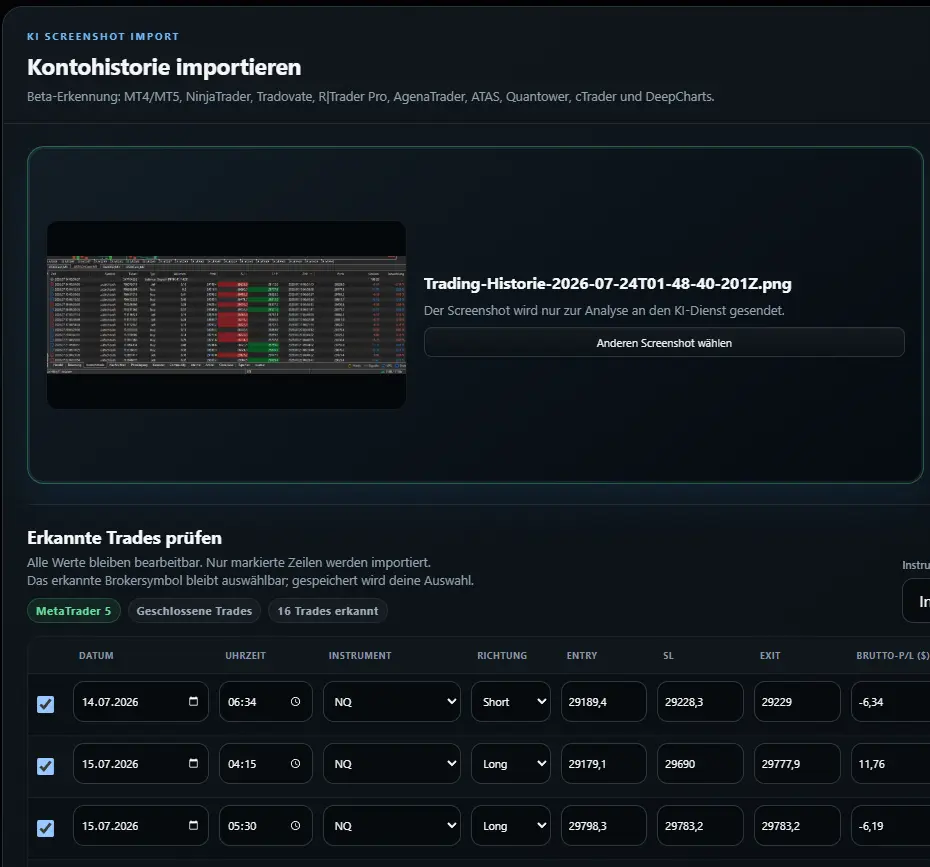
Read dates, symbols, direction, prices or outcomes from a supported screenshot or file, then place the detected values into a reviewable structure.
Standardize the record
Map data into consistent journal fields so accounts, symbols and sessions can be filtered without rebuilding the structure for every review.
Expose missing context
Highlight blank or uncertain fields that require the trader to return to the source rather than silently treating missing information as fact.
Prepare pattern questions
Organize records by setup, timing, account or risk so the trader can ask whether a repeated behavior is supported by enough valid examples.
Separate process from outcome
Put rule adherence, planned risk and execution notes beside P/L so a winning trade is not automatically labelled a well-executed trade.
Structure review notes
Turn verified observations into a concise daily or weekly checklist. The trader still decides what is relevant and what should change.
A CONTROLLED WORKFLOW
Import, verify, save, then review.
The confirmation step is not an inconvenience. It is what protects the journal from turning a confident extraction error into misleading performance analysis.
- 01Provide the source
Use a supported screenshot, file or manual record.
- 02Preview detection
Let the import workflow structure the visible trade fields.
- 03Verify every value
Check dates, direction, prices, size and result against the source.
- 04Confirm the record
Save only after corrections and missing context are resolved.
- 05Review the process
Use verified data for performance and behavior review.
WHY VERIFICATION MATTERS
A clean interface does not guarantee clean data.
Dates can be interpreted in the wrong order. Timestamps can move when time zones are handled inconsistently. A screenshot can omit fees or partial exits. Symbol names can differ between brokers. Each of these issues can distort later analysis.
Date-only values and timestamps deserve separate checks. A blanket time-zone correction should never replace finding where a shift entered the parser, API, database or display chain.
AI LIMITS
What an AI trade journal should do
Appropriate assistance
- Structure user-supplied trade information.
- Flag uncertain or missing fields for review.
- Group verified records for comparison.
- Help formulate review questions from journal data.
- Summarize observations the trader can inspect.
Claims to reject
- Predicting the next profitable trade.
- Guaranteeing performance or consistency.
- Inventing missing values or market context.
- Treating correlation as proof of a trading edge.
- Replacing financial judgment or professional advice.
BETTER QUESTIONS
Six layers of analysis worth keeping separate
Combining every observation into one score can hide more than it reveals. Keep data coverage, execution quality, outcome, confidence, context and next action distinct before drawing conclusions.
Is the record complete?
Check whether entry, exit, size, fees, timestamps, setup and notes are available. Missing data should remain unknown. It must never silently become zero.
Did the trade follow the plan?
Review planned risk, rule compliance and management decisions without letting a later winning or losing outcome rewrite the original process.
What actually happened?
Measure P/L, R-multiple, drawdown and other results as outcomes. They matter, but they are not a complete description of decision quality.
How strong is the evidence?
A pattern from a small or incomplete sample deserves lower confidence than one supported by consistent definitions and sufficient comparable trades.
Are the trades comparable?
Separate accounts, instruments, sessions and setups where the underlying conditions differ. Aggregated numbers can mask conflicting behaviors.
What can be tested next?
Turn an observation into one measurable review question. Avoid changing several rules at once based on an AI-generated summary.
DATA AND PRIVACY
Know what leaves your device before you upload it.
Trade screenshots and account exports can contain account identifiers, balances, broker details or other information you may not intend to share. Review and crop sources where appropriate, and understand the service's storage, processing and deletion practices.
Never paste passwords, API secrets, recovery codes or payment credentials into an AI journal. Read the applicable privacy information before using an upload feature.
- Remove unrelated account and personal identifiers.
- Confirm which data is processed and for what purpose.
- Use read-only or export-based workflows where appropriate.
- Check retention, access control and deletion options.
- Keep original source records for later verification.
BTI PULSE TODAY
AI-assisted capture with a confirmation step.
PULSE currently supports an AI-assisted screenshot import workflow that prepares visible trade data for review. The trader checks the preview and decides what is saved. Manual entry remains available, and supported imports can bring existing records into the journal.
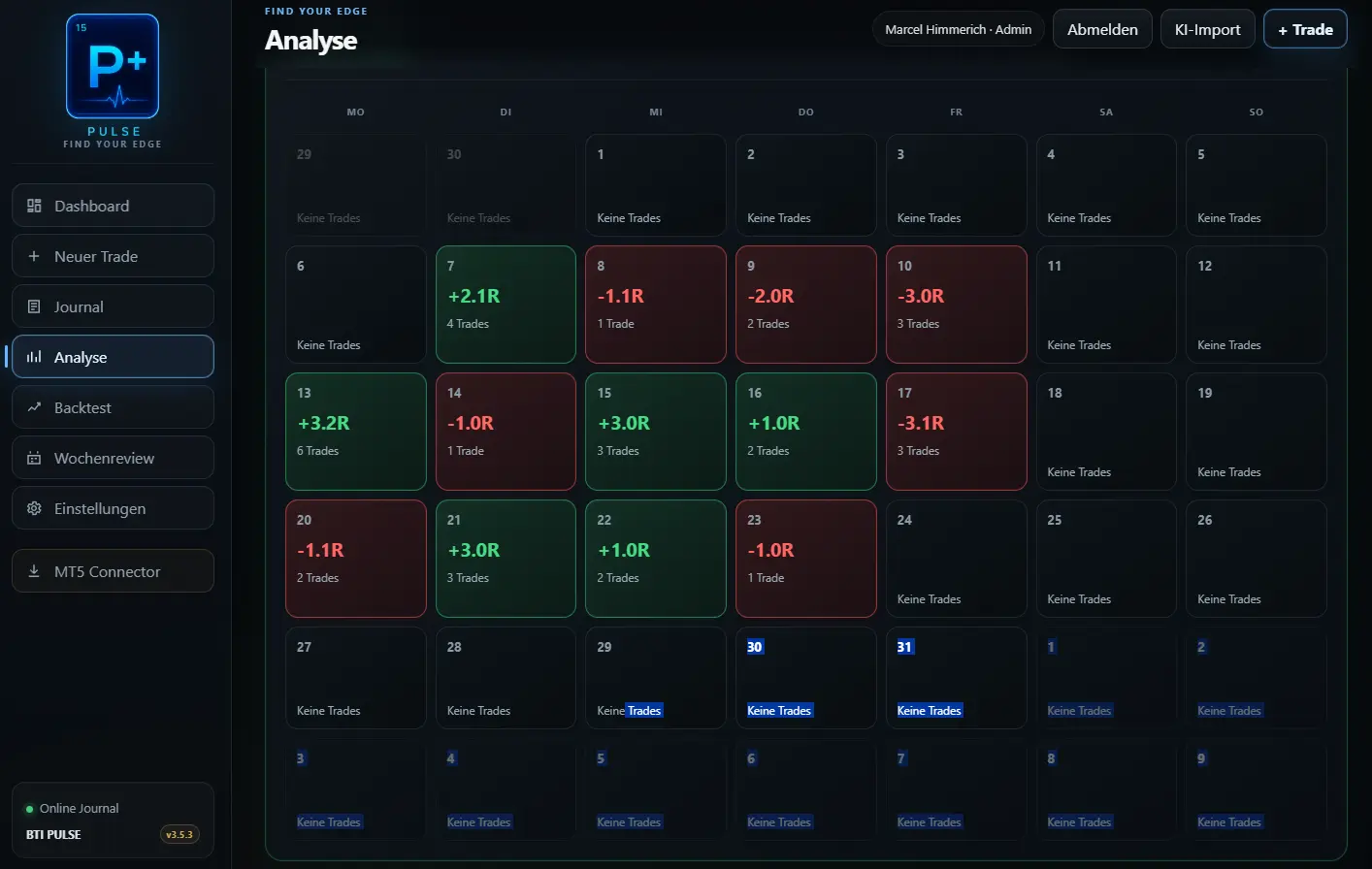
After confirmation, PULSE provides structured journal and performance views. It does not predict trades, issue buy or sell signals or guarantee that an analysis will improve results.
FAQ
Questions about AI trading journals
What does an AI trading journal actually do?
Capabilities vary. Useful functions can include structuring user-supplied trade data, assisting with imports, grouping records and preparing review summaries. The source data and conclusions still need to be checked.
Can an AI journal predict profitable trades?
No reliable journal should promise that. Historical patterns can support review questions, but they do not guarantee future market behavior or profitable decisions.
Should AI-detected trades be saved automatically?
A preview and confirmation step is safer. Dates, prices, symbols, direction and fees can be incomplete or misread, so detected values should be checked against the original source.
Can AI analyze a screenshot of trade history?
Supported tools can read visible trade fields from certain screenshots. Accuracy depends on image quality, platform layout and the fields shown. A screenshot may omit information required for a complete journal record.
Is an AI journal better than normal trading journal software?
Not automatically. Good software first needs reliable capture, correction tools, useful metrics, filtering and a repeatable review workflow. AI is valuable only when it improves those jobs without hiding uncertainty.
Does BTI PULSE make trading decisions?
No. PULSE is a journal and analysis environment. Its AI-assisted import helps prepare trade data for trader review; it does not generate autonomous buy or sell decisions.
CAPTURE LESS MANUALLY · VERIFY MORE DELIBERATELY
Let AI reduce friction. Keep control.
Use a controlled import, confirm the source data and keep every conclusion open to review.
Explore PULSE